Did you know that in Hebrew, the word for ground or earth (adamah) has the same root as the word for man or human (adam)? As some of my former college students once said during a Bible study on the creation stories in Genesis, “we’re dirt people!” It was definitely a term of endearment. (My friend Colleen has since taught me the difference between dirt and soil and it turns out we’re actually soil people, but the endearment behind the term still stands!)
This week, many Christian communities will gather to observe Ash Wednesday, the beginning of the season of Lent. Often those observances include worshipers receiving the sign of the cross on their forehead in ash, along with the words “from dust you came, and to dust you will return.” That phrase also comes from Genesis, when God is talking to Adam and Eve after they eat from the tree of knowledge of good and evil. “Dust,” there, is a different Hebrew word than adamah, but the connection between the earth and us and the messy work of being a person was the jumping off point for this prayer.
You might pray this prayer near Ash Wednesday, or another time. And while it’s formatted to go along with prayer beads, I hope it’ll make a meaningful reflection with our without something to hold. Keep reading for a few logistical notes about prayer beads, or click here to skip straight to the guided reflection.
About Prayer Beads
I first learned about Protestant prayer beads several years ago, when I came across Kristen E. Vincent’s book A Bead and a Prayer. Here are some prayer bead FAQs on her website, including explanations of the different beads’ names and a link to how to make your own. In this post from 2018 (572 years ago?) I talked about how I adapted Vincent’s original DIY directions. There are also lots of pre-made ones, like all of these on Etsy. Just look for sets that match the layout of the image below if you want the prompt to match up all the way. The general idea is that you hold each bead as you pray the corresponding part of the reflection. But when it comes down to it, choose your own adventure and use your prayer beads however is most meaningful to you.
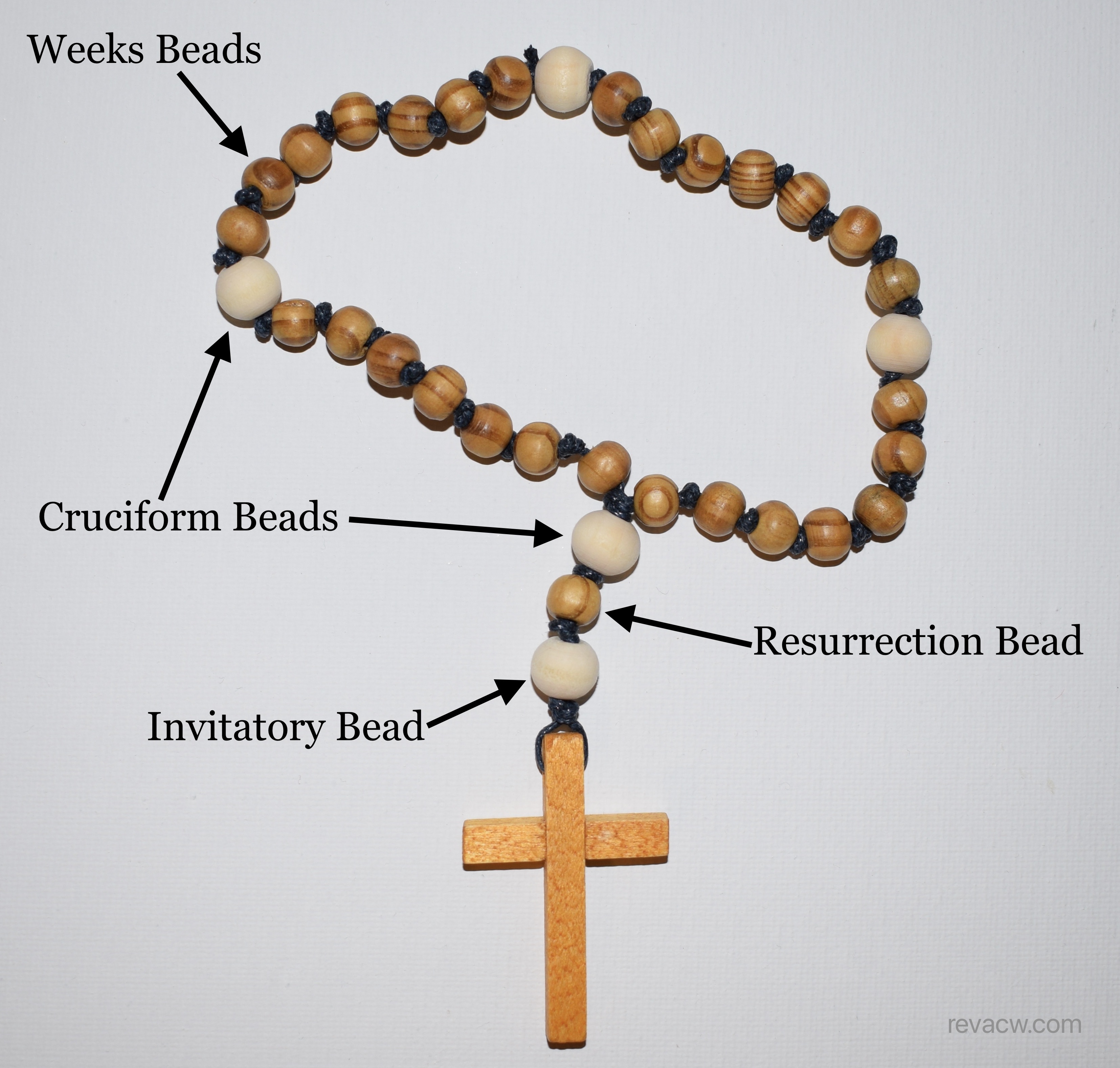
As you hold each bead…
Invitatory Bead | Begin with a breath prayer, slowly repeating the same short phrase(s) with each deep inhale and exhale. Use these words inspired by Psalm 139 or choose your own. (More info about breath prayers is included below.)
Search me, O God…and know my heart.
Resurrection Bead | God of life, from the very beginning we have been grounded in your love. May those roots bind me to all of creation, reminding me who I am and what is mine to do.
1st Cruciform Bead | Read Genesis 2:5-7.
On the day the Lord God made earth and sky — before any wild plants appeared on the earth, and before any field crops grew, because the Lord God hadn’t yet sent rain on the earth and there was still no human being to farm the fertile land, though a stream rose from the earth and watered all of the fertile land — the Lord God formed the human from the topsoil of the fertile land and blew life’s breath into his nostrils. The human came to life. (CEB)
Context: Genesis 2:4b-25
Weeks Beads, Set 1 | In gratitude for the way God knits us together with all of creation, on each of these beads, give thanks for a part of creation that also feels like part of who you are. (A natural place, specific flora or fauna or broader categories of them, even a fellow human being…)
A note for all of the weeks beads: If you run out of ideas before you run out of beads, you can totally pray for the same thing twice.
2nd Cruciform Bead | Read Luke 8:4-8, 15.
When a great crowd was gathering and people were coming to Jesus from one city after another, he spoke to them in a parable: “A farmer went out to scatter his seed. As he was scattering it, some fell on the path where it was crushed, and the birds in the sky came and ate it. Other seed fell on rock. As it grew, it dried up because it had no moisture. Other seed fell among thorny plants. The thorns grew with the plants and choked them. Still other seed landed on good soil. When it grew, it produced one hundred times more grain than was scattered.” As he said this, he called out, “Everyone who has ears should pay attention.” … The seed that fell on good soil are those who hear the word and commit themselves to it with a good and upright heart. Through their resolve, they bear fruit. (CEB)
Context: Luke 8:4-15
Weeks Beads, Set 2 | When you think of “good soil,” what comes to mind? What qualities in a place, community, or person most encourage you to hear God’s presence or guidance? On each bead, name one of those things.
3rd Cruciform Bead | Read Jeremiah 18:1-4.
The word that came to Jeremiah from the Lord: “Come, go down to the potter’s house, and there I will let you hear my words.” So I went down to the potter’s house, and there he was working at his wheel. The vessel he was making of clay was spoiled in the potter’s hand, and he reworked it into another vessel, as seemed good to him. (NRSVUE)
Weeks Beads, Set 3 | On each bead, name a place, institution, or person in need of transformation. Maybe the things you name are starting in a tough place, or maybe they’re mostly okay and just need some renewal. There’s room here for whatever’s taking up space in your brain and your heart — including making some room for yourself.
4th Cruciform Bead | Read John 9:4-7.
While it’s daytime, we must do the works of him who sent me. Night is coming when no one can work. While I am in the world, I am the light of the world.” After he said this, he spit on the ground, made mud with the saliva, and smeared the mud on the man’s eyes. Jesus said to him, “Go, wash in the pool of Siloam” (this word means sent). So the man went away and washed. When he returned, he could see. (CEB)
Context: John 9:1-12
Weeks Beads, Set 4 | In this story of healing, Jesus uses the earth around him, but also gives of himself. It’s messy and a little (a lottle?) weird, but Jesus doesn’t shy away from the work to be done. On each bead, consider a way you or the communities you’re part of might use the gifts, privilege, or resources you already have to work toward healing part of creation (whether part of the natural world or human-made society).
Resurrection Bead | God of life, from the very beginning we have been grounded in your love. May those roots bind me to all of creation, reminding me who I am and what is mine to do.
Invitatory Bead | Pray the same breath prayer you began with.
Search me, O God…and know my heart.
Amen.
About Breath Prayers
The breath prayer is a spiritual discipline that has been practiced for centuries by our church ancestors, using a person’s own breath to help center them. The breath prayer is a way to focus on one thought, image, or short phrase, that in turn fastens your heart on God. This contemplative prayer can be used in your daily routine or in particular times of anxiety, fear, or frustration. You can choose one of the prompts below, or make up your own.
- Get into a comfortable posture for praying — sitting, laying, standing or whatever else works for you.
- Ask God to calm your mind and heart. Slow your breathing and notice the rhythm of your breath.
- Repeat silently a prayer in whatever rhythm is most comfortable with your breathing. Some examples are below, but feel free to come up with your own. Don’t stress out too much about counting, but try repeating your prayer at least 10 times (or set a timer if that helps.)







Leave a Reply